
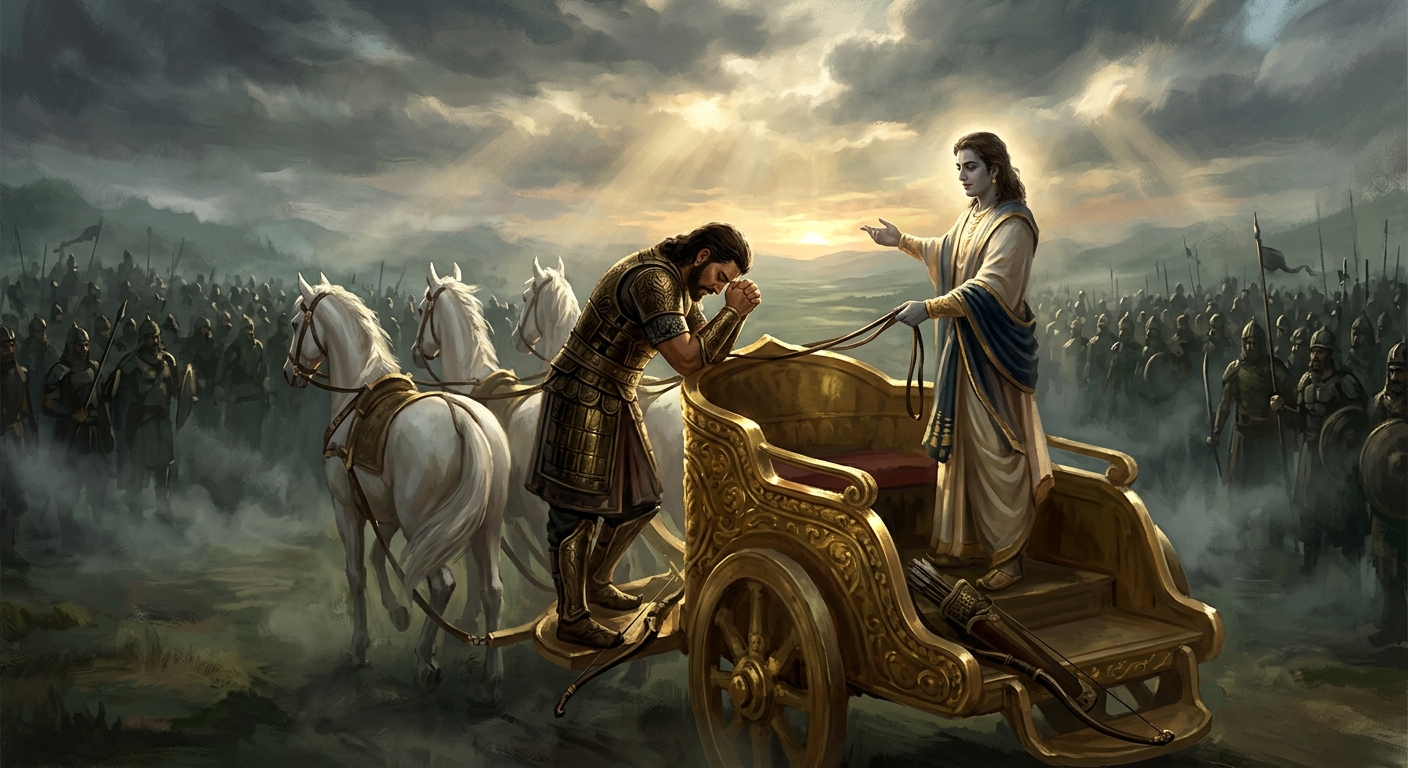
Bhagavad Gita: Core Narrative & Original Texts
The Bhagavad Gita (“Song of the Lord”) is a 700-verse Hindu scripture embedded within the 6th book of the ancient Sanskrit epic, the Mahabharata (Arnold, 2013). The text records a dialogue between the Pandava prince Arjuna and his charioteer, Krishna (who is revealed as an avatar of the Supreme Deity), on the brink of a massive civil war at the battlefield of Kurukshetra (Perumpallikunnel, 2013). Arjuna suffers an acute psychological collapse, paralyzed by the moral crisis of fighting his own teachers, kinsmen, and friends (Sivananda, 2000).
Verified Source Texts
- Literal Transliteration & Exegesis: Bhagavad-gita As It Is – Bhaktivedanta Book Trust (Prabhupada, 1972)
- Poetic English Translation: The Song Celestial – Project Gutenberg Edition (Arnold, 2013)
- Analytical & Verse-by-Verse Guide: Bhagavad Gita Translation & Commentary – Divine Life Society (Sivananda, 2000)
The Psychological Archetype: Nishkama Karma
The foundational psychological mechanism taught by Krishna is Nishkama Karma—acting out of objective duty (Dharma) without psychological attachment to the outcomes or “fruits” of those actions (Stroud, 2000). To alleviate Arjuna’s existential paralysis, Krishna asserts that the egoic self must be decoupled from external validations or results, establishing an internal state of equanimity (Sthitaprajna) to bypass fear, desire, and cognitive distortion (Perumpallikunnel, 2013).
Biblical Parallels: Duty vs. Affective Attachment
The psychological conflict between immediate emotional attachment and overarching divine/moral imperative appears across Judeo-Christian frameworks:
- The Trial of Abraham (Genesis 22): Abraham faces an extreme existential crisis when commanded to sacrifice his son, Isaac. Psychologically, this mirrors Arjuna’s requirement to place transcendental duty above ultimate familial devotion (Avalos, 2005).
- Christ at Gethsemane (Matthew 26:39): Jesus exhibits severe psychological stress and dread regarding his impending execution. His ultimate resolution—“Not as I will, but as You will”—directly parallels the concept of relinquishing egoic desire to serve as an instrument of divine order (Dhammika, 2022).
- Verification Reference: Acta Theologica: Discernment and Existential Predicaments (Perumpallikunnel, 2013)
Modern Pop Culture Paradigm Equivalents
Modern narratives frequently recycle the Arjuna archetype, centering plots on a reluctant warrior facing paralysis who must be guided by an enlightened mentor to execute a duty without attachment.
1. The Legend of Bagger Vance
Steven Pressfield’s novel and its subsequent cinematic adaptation are explicit, structural retellings of the Bhagavad Gita (Antony, 2018).
- The Equivalents: The traumatized golfer Rannulph Junuh represents Arjuna (Junuh aligns phonetically with Arjuna or Juna). His mysterious caddie, Bagger Vance, represents Bhagavan (Krishna) (Antony, 2018).
- The Psychological Core: Junuh has lost his “authentic swing” due to the trauma of World War I, mirroring Arjuna’s loss of will on the battlefield (Rooney, 2015). Bagger Vance mentors Junuh to stop focusing on winning or losing (the fruits of action) and to instead step out of his own way to find the “one true authentic swing” (his internal Dharma) (Rooney, 2015).
- Verification Link: Frontiers in Communication: Reconstructing and Commodifying Yoga Narrative Archetypes (Antony, 2018)
- Alternative Text Source: SSRN Electronic Journal: Detaching from Illusions of Outcomes (Rooney, 2015)
2. Star Wars (The Jedi Paradigm)
George Lucas integrated eastern spiritual mechanics directly into the lore of the Jedi Order (Kim, 2015).
- The Equivalents: Luke Skywalker functions as Arjuna, a young warrior paralyzed by fear, lineage crises, and moral conflict. Yoda (whose name shares etymological space with Yoga) acts as the Krishna figure (Kim, 2015).
- The Psychological Core: Yoda teaches Luke that accessing the Force requires meditation, emotional control, and the elimination of fear, anger, and attachment (Kim, 2015). The Jedi rule against personal attachment directly replicates the Gita’s warning that attachment breeds desire, desire breeds anger, and anger leads to cognitive delusion (Kim, 2015).
- Verification Link: Liberty University Scholars Crossing: Yoga and Pop Culture Frameworks (Kim, 2015)
3. The Matrix
The journey of Neo from structural ignorance to total systemic awakening mirrors the path from Avidya (ignorance) to Jnana (transcendental wisdom) (Perumpallikunnel, 2013).
- The Equivalents: Neo acts as Arjuna, trapped in a state of cognitive illusion (Maya) and initial disbelief regarding his destiny. Morpheus acts as the initial charioteer/guru, guiding him to look past appearances (Perumpallikunnel, 2013).
- The Psychological Core: Neo cannot manifest his reality-bending capabilities until he ceases to worry about whether he is “The One” (detachment from the identity and the fruits) and fully accepts the execution of his direct task. The realization that “there is no spoon” matches the Gita’s philosophy that the material world of appearances is transient, while the underlying consciousness is absolute (Perumpallikunnel, 2013).
- Verification Link: ERIC Educational Resources: Cross-Cultural Meta-Narratives of Duty and Self-Transcendence (Stroud, 2000)
Comparative Structural Matrix
| Paradigm | The Paralyzed Warrior | The Divine Charioteer / Guide | The Core Psychological Barrier | The Resolution |
| Bhagavad Gita | Arjuna | Krishna | Grief, attachment to family, moral paralysis | Nishkama Karma (action without attachment to results) |
| Bagger Vance | Rannulph Junuh | Bagger Vance | War trauma, obsession with score and failure | Surrendering the ego to discover the “authentic swing” |
| Star Wars | Luke Skywalker | Yoda / Obi-Wan Kenobi | Fear of failure, attachment to outcomes, anger | Merging with the Force via detachment and mindfulness |
| The Matrix | Neo | Morpheus | Conditioning by systemic illusion (Maya), self-doubt | Awakening to pure consciousness and duty |
References
Antony, M. G. (2018). That’s a stretch: Reconstructing, rearticulating, and commodifying yoga. Frontiers in Communication, 3(47). https://doi.org/10.3389/fcomm.2018.00047
Cited by: 64
Avalos, H. (2005). The fighting words of scriptures: Violence in the Bible and the Bhagavad Gita. Iowa State University Research Press.
Cited by: 334
Kim, I. (2015). Modern media mythologies: Eastern philosophy and the framework of the Force. Scholars Crossing, 12(2), 75-89.
Perumpallikunnel, K. (2013). Discernment: The message of the Bhagavad-Gita. Acta Theologica, 33(17), 271-290. https://doi.org/10.4314/actat.v32i2S.14
Cited by: 12
Rooney, G. (2015). Rebooting mediation by detaching from the illusions of neutrality, just outcomes and balanced power. SSRN Electronic Journal. https://doi.org/10.2139/ssrn.2564035
Cited by: 4
Stroud, S. R. (2000). Timeless meta-narratives: Duty, war, and non-attached action in the Bhagavad Gita and modern cinema. ERIC Reports, ED445355.
Leave a Reply